(TITC) – Located in the newly established Thung Nai Commune of Phu Tho Province, formed from the former communes of Thung Nai, Bac Phong, and Binh Thanh of Hoa Binh, Mo Hamlet has preserved an impressive degree of traditional Muong cultural identity. Today, it stands as one of the most charming and authentic stops for travellers seeking meaningful cultural encounters and rural experiences.
Set within the scenic Thung Nai area, Mo Hamlet is surrounded by lush terraced fields and verdant mountains. The community is home primarily to the Muong people, and the hamlet is renowned for its numerous well-preserved traditional stilt houses. In July 2024, the People’s Committee of Binh Province recognised Mo Hamlet as an official community-based tourist site under Decision No. 1419/QĐ-UBND, and the area was subsequently rated a four-star product under the local OCOP (One Commune One Product) programme, affirming both its quality and cultural value.
The most distinctive feature of Mo Hamlet lies in its stilt-house architecture, closely tied to the customs, rituals, and daily life of the Muong. Nearly 200 Muong households live here, more than half of which still inhabit original stilt houses that have been carefully preserved. The structures, supported by aged wooden pillars, topped with palm-leaf roofs, and accessed by weather-worn wooden staircases, form a living museum, telling the story of a community that has long thrived in harmony with its natural environment.
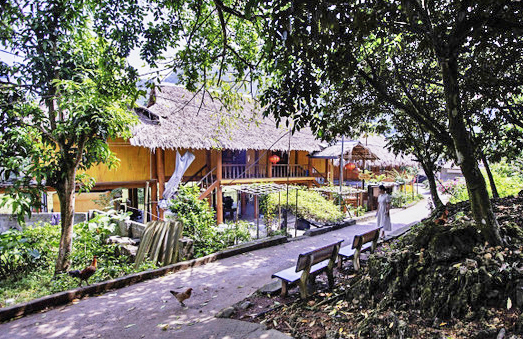
Mo hamlet space is peaceful and green (Photo: Collection)
Muong stilt houses are traditionally built along hillsides to suit daily needs and adapt to the terrain. The upper loft, near the roofline, is used for storing food and household goods; the central floor serves as the family’s main living and resting area; while the ground-level space is used for keeping tools, hosting guests, and welcoming visitors. The kitchen is considered the heart of every Muong home. More than a place for preparing meals, it is where family gatherings, conversations with guests, and intimate cultural exchanges occur, all within the warm glow of the hearth, a symbol of unity and ancestral heritage.
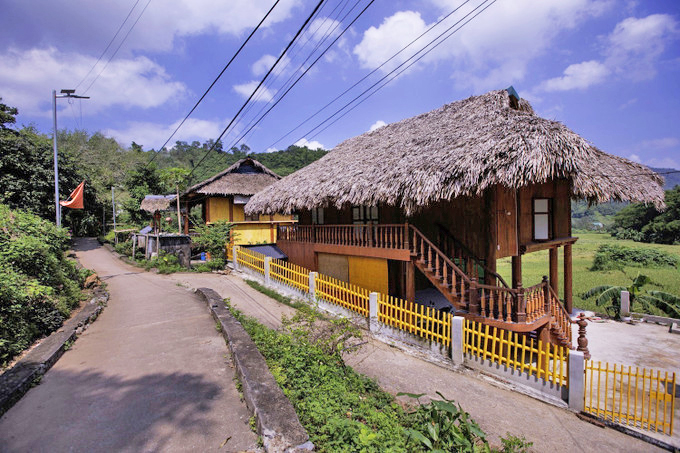
The national target program on socio-economic development in ethnic minority and mountainous areas for the 2021-2025 period has made an important contribution to improving the lives of people in Mo hamlet (Photo: Collection)
Visitors to Mo Hamlet can enjoy the tranquillity of this rural hideaway, breathe in the fresh mountain air, and stroll through the village landscape. Popular activities include checking in at seasonal terraced fields, visiting farms, observing daily livelihoods such as weaving, rice planting, maize harvesting, animal care, and fishing in the nearby streams. Overnight stays are available in local homestays equipped with essential comforts. Guests are served traditional Muong delicacies such as upland sticky rice, com lam (rice cooked in bamboo tubes), stream fish, pomelo-leaf pork rolls, free-range chicken, forest vegetables, bitter bamboo shoots, and ruou can (jar wine). Evening programmes often feature gong performances, ethnic dance shows, campfires, cultural exchanges, and bamboo pole dancing. From Mo Hamlet, travellers can easily extend their journey to the Cu Chinh Lan Heroic Relic Site, the Muong Cultural Space Museum, Red Dao villages, or explore the famed Thung Nai area, Ngoi Hoa Bay, and Thac Bo Temple by Hoa Binh Lake.
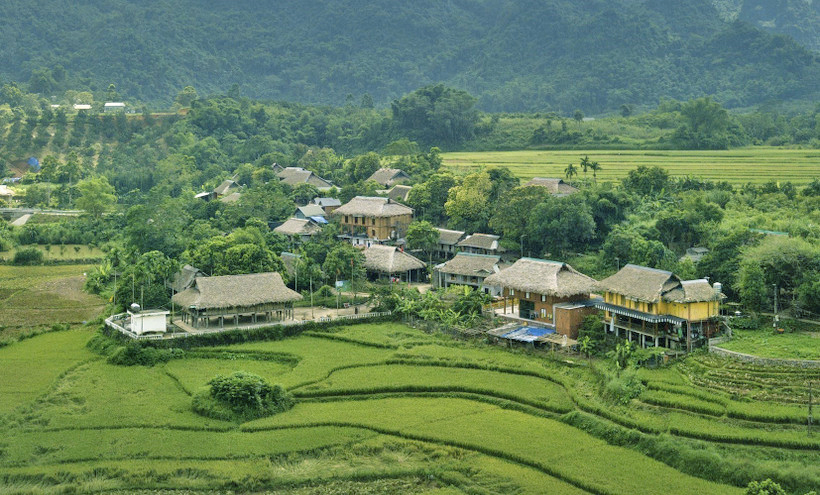
Xom Mo still preserves many traditional stilt houses (Photo: TITC)
According to Mr. Nguyen Viet Phuong, Chairman of the Thung Nai Commune People’s Committee, local authorities place strong emphasis on linking tourism development with cultural preservation, particularly in Mo Hamlet, where every house, dance, and traditional dish represents a valuable part of Muong heritage. Regular training sessions are organised to improve tourism skills, while residents receive ongoing support in landscape management, waste collection, and maintaining a clean, green environment for visitors.
Chairman Phuong also noted that the national target programme for socio-economic development in ethnic minority and mountainous areas for the period 2021–2025 has significantly improved the livelihoods of Mo Hamlet residents. Support in capital, farming techniques, and agricultural-tourism models have empowered households to develop signature Muong products. The gong, the dance movements, traditional brocade weaving, and even dishes such as com lam have become valuable cultural assets that enrich the tourism experience, contributing to a better quality of life for the community.
Tourism Information Technology Center